Piano workbooks in PDF format offer structured learning, combining exercises and musical pieces. They’re ideal for self-study or supplementing lessons,
providing a focused path for beginner pianists to develop essential skills.
These resources often include foundational concepts like note reading, rhythm, and basic technique, all conveniently accessible as a downloadable PDF.
What is a Piano Workbook?
A piano workbook is a comprehensive resource designed to guide aspiring pianists through the initial stages of learning. Unlike standard sheet music collections, a workbook systematically builds skills, presenting concepts in a progressive manner. These resources typically blend theoretical explanations with practical exercises, fostering a holistic understanding of music.
For beginners, a piano workbook often starts with fundamental elements like identifying notes on the staff, understanding rhythm and time signatures, and developing proper finger technique. It’s a curated learning path, unlike simply attempting to play songs without a solid foundation.

The PDF format enhances accessibility, allowing students to easily download, print, or view the material on various devices. Workbooks like Czerny’s “Practical Method for Beginners” and Hanon’s exercises are classic examples, offering structured drills to improve dexterity and musicality. They are designed to furnish young players with an easy introduction to the art of playing the pianoforte.
Why Use a PDF Format?
Choosing a piano workbook in PDF format offers significant advantages for learners. Primarily, it provides unparalleled accessibility – downloadable onto any device (tablets, laptops, smartphones) for practice anywhere, anytime. This eliminates the need to carry physical books, making learning more convenient.
PDFs also allow for easy printing of specific exercises or sections, tailoring the learning experience. Furthermore, digital workbooks often support annotation, enabling students to mark progress, add notes, or highlight challenging areas directly within the document.
The format is cost-effective, frequently offering lower prices compared to physical copies. Resources like those by Czerny, Hanon, and Heller are readily available as PDFs. Combined with tools like LilyPond for formatting, and apps like Simply Piano, the PDF format seamlessly integrates into a modern, flexible learning environment.

Essential Exercises Found in Beginner Piano Workbooks
Beginner piano workbooks prioritize exercises for single-hand technique, both-hand coordination, note recognition, and rhythmic understanding. These build a solid foundation.
They often include simple melodies to apply learned skills.
Exercises in Touch for One Hand
Exercises focusing on single-hand technique are foundational in beginner piano workbooks. These typically begin with simple five-finger scales and arpeggios, emphasizing proper finger curvature and evenness of tone. PDF workbooks often include exercises designed to develop finger independence, where each finger is practiced individually to build strength and control.
Repetitive patterns, like playing a single note or chord repeatedly, are common. These build muscle memory and improve touch. Workbooks may also incorporate exercises that focus on different articulations – legato (smooth and connected) and staccato (short and detached) – to develop expressive playing. The goal is to establish a comfortable and controlled hand position, ensuring efficient technique before introducing the complexities of playing with both hands. These exercises are crucial for building a solid technical base.
Gradual increases in difficulty, such as extending the range of scales or adding rhythmic variations, are typical.
Exercises for Both Hands Together
Transitioning to two-handed exercises in a piano workbook (PDF) marks a significant step for beginners. These exercises initially focus on simple coordination, often involving playing the same rhythm or a basic chord progression in both hands simultaneously. Early exercises frequently utilize five-finger patterns, mirroring those practiced with one hand, but now coordinated between left and right.
Workbooks progressively introduce more complex rhythms and harmonies, challenging students to maintain independence between their hands. Common exercises include playing scales and arpeggios in contrary motion (hands moving in opposite directions) and simple chord voicings. The emphasis is on developing a sense of balance and coordination, ensuring both hands contribute equally to the musical texture;
These exercises build essential skills for playing more advanced repertoire and are often presented with clear fingering suggestions.
Reading Music: Note Recognition
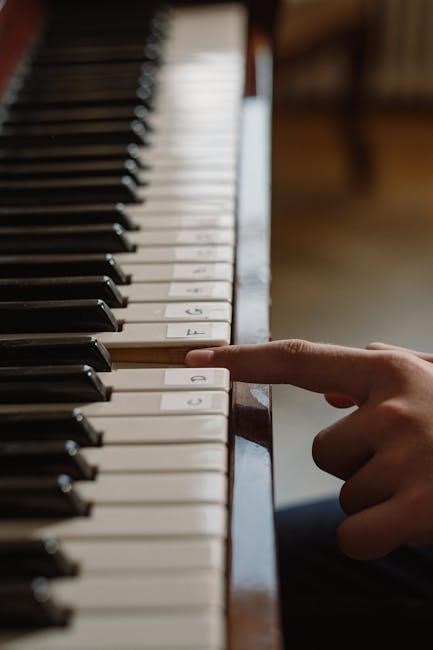
Piano workbooks (PDF) dedicate substantial sections to note recognition, a cornerstone of musical literacy. Beginners typically start with identifying notes on the treble and bass clef staves, often focusing on landmark notes like middle C, G, and F. Exercises commonly involve naming notes individually, then identifying them within simple melodies.
Workbooks employ various techniques, such as flashcards, note-naming drills, and connecting notes to their corresponding keys on the piano. PDF formats allow for interactive elements, like circling correct answers or writing note names directly onto the page.
Gradually, the exercises introduce ledger lines and more complex note patterns. The goal is to develop fluent and accurate note reading, enabling students to decode musical notation with confidence and play melodies independently.
Understanding Basic Rhythm and Time Signatures
Piano workbooks (PDF) systematically introduce basic rhythm and time signatures, crucial for accurate musical performance. Beginners learn to identify note values – whole, half, quarter, and eighth notes – and their corresponding rests. Exercises often involve clapping or tapping rhythms before playing them on the piano.
Workbooks explain time signatures (like 4/4, 3/4, and 2/4), demonstrating how they dictate the number of beats per measure and the type of note that receives one beat. PDF formats can include audio examples to reinforce rhythmic concepts.
Progressive exercises build from simple rhythms to more complex patterns, incorporating dotted notes and ties. The aim is to develop a strong internal sense of pulse and the ability to accurately interpret and perform rhythmic notation.
Popular Beginner Piano Workbook Options (PDF)
Czerny, Hanon, and Heller are renowned composers offering beginner piano workbooks (PDF). These resources provide progressive exercises and etudes for skill development.
These PDF options are widely available and trusted by piano teachers and students alike, fostering a solid foundation.
Czerny ⏤ Practical Method for Beginners
Carl Czerny’s Practical Method for Beginners is a cornerstone of piano education, available widely as a PDF. This workbook systematically introduces fundamental piano techniques, focusing on finger dexterity, hand independence, and accurate note reading. It’s designed for students taking their very first steps with the instrument.
The method progresses gradually, starting with simple exercises in each hand before combining them. Czerny emphasizes clarity and precision, building a strong technical base. The PDF format allows for easy printing and annotation, making it a versatile learning tool. Many editions include fingering suggestions to guide beginners.
Beyond technical drills, the workbook incorporates short, accessible musical pieces, allowing students to apply their newly acquired skills in a musical context. This blend of exercises and repertoire keeps learning engaging and motivating. It’s a highly recommended resource for anyone seeking a structured and comprehensive introduction to the piano.
Hanon: The Virtuoso Pianist
Charles-Louis Hanon’s The Virtuoso Pianist, frequently found as a PDF download, is renowned for its intensive finger exercises. While often associated with advanced technique, the initial exercises are surprisingly beneficial for beginners, building finger strength, evenness, and independence. It’s a classic, though sometimes debated, approach to piano technique.
The workbook consists of a series of short, repetitive exercises designed to isolate and strengthen individual fingers. These exercises, when practiced correctly, can improve dexterity and control. The PDF format allows students to easily access and practice these drills. However, it’s crucial to emphasize proper technique to avoid tension and injury.
Beginners should approach Hanon cautiously, focusing on relaxed hand positions and controlled movements. Supplementing Hanon with musical pieces is essential to develop musicality alongside technical proficiency. It’s a powerful tool when used thoughtfully as part of a well-rounded learning plan.
Stephen Heller ― Etudes préliminaires pour apprendre les notes
Stephen Heller’s Etudes préliminaires pour apprendre les notes (Preliminary Studies for Learning the Notes) is a valuable resource, often available as a PDF, specifically designed for beginner pianists. Unlike purely technical exercises, Heller’s etudes are short, musical pieces that introduce notes gradually and contextually. This approach makes learning more engaging and musically rewarding.
The workbook focuses on introducing notes within simple melodic lines, helping students connect note recognition with actual music-making. The exercises progress systematically, building upon previously learned concepts. The PDF format allows for convenient printing and annotation, aiding in focused practice.
Heller’s etudes emphasize musicality from the start, encouraging students to pay attention to phrasing and dynamics. They are a fantastic complement to more technical studies, fostering a holistic approach to piano learning. They are considered a cornerstone of early piano education.
Key Features to Look for in a Beginner Piano Workbook
Essential qualities include a gradual difficulty curve, clear instructions, technique-focused exercises, and simple songs. A good PDF workbook builds skills progressively;
Gradual Progression of Difficulty
A cornerstone of effective piano workbooks, especially for beginners, is a carefully planned progression of difficulty. Starting with very basic concepts – perhaps just identifying notes on the staff or playing simple five-finger exercises – is crucial for building confidence and avoiding frustration. The best PDF workbooks don’t immediately throw complex rhythms or challenging chords at the student.
Instead, they introduce new elements incrementally. For example, a workbook might begin with whole and half notes, then gradually introduce quarter notes, eighth notes, and rests. Similarly, exercises will start with one hand at a time, focusing on proper finger technique and hand position, before progressing to coordinating both hands together.
This step-by-step approach allows the learner to master each concept before moving on, solidifying their understanding and preventing them from feeling overwhelmed. Look for workbooks that clearly indicate the level of each exercise or piece, and that offer a logical sequence of learning. A well-structured workbook will feel manageable and encouraging, fostering a positive learning experience.
Clear and Concise Instructions
Beginner piano students often struggle not just with the physical act of playing, but also with understanding musical terminology and instructions. Therefore, a high-quality piano workbook PDF must prioritize clarity and conciseness in its explanations. Ambiguous wording or overly complex phrasing can quickly derail a learner’s progress.
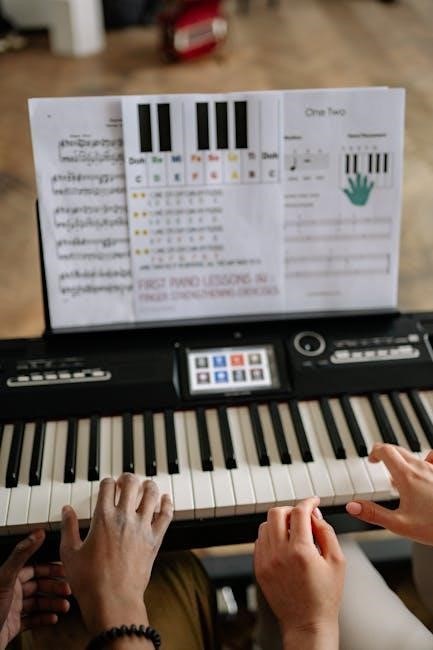
Instructions should be straightforward and easy to understand, avoiding jargon whenever possible. When technical terms are necessary, they should be clearly defined. Diagrams and illustrations are incredibly helpful, visually demonstrating proper hand position, fingerings, and musical symbols.
The best workbooks break down each exercise into small, manageable steps, with clear guidance on what the student should focus on. Concise explanations paired with visual aids ensure that the learner can independently grasp the concepts and practice effectively. A well-written workbook empowers self-directed learning and minimizes frustration.
Focus on Technique and Finger Exercises
A fundamental aspect of any effective piano workbook PDF for beginners is a strong emphasis on technique and finger exercises. Building a solid technical foundation early on is crucial for preventing bad habits and enabling future progress. These exercises aren’t merely about rote repetition; they’re about developing finger strength, dexterity, and independence.
Workbooks should include exercises like scales, arpeggios, and Hanon-style drills, presented in a progressive manner. Finger exercises should focus on proper hand position, wrist flexibility, and evenness of touch. Clear indications of fingering are essential, guiding the student to use the correct digits for each note.
The goal is to cultivate a relaxed and efficient technique, allowing the student to play with greater control and musicality. A piano workbook that prioritizes technique lays the groundwork for a lifetime of enjoyable piano playing.

Inclusion of Simple Songs and Melodies
While technical exercises are vital, a truly engaging piano workbook PDF for beginners must also include simple songs and melodies. Applying newly learned skills to actual music provides motivation and reinforces understanding. These pieces should be carefully selected to align with the student’s current level, offering a sense of accomplishment without being overly challenging.
Beginner-friendly arrangements of familiar tunes, folk songs, or original compositions are ideal. The inclusion of lyrics can further enhance the learning experience, connecting the music to a narrative or emotional context. Simple songs help students develop sight-reading skills, rhythm recognition, and musical expression.
A good piano workbook will gradually introduce more complex melodies and harmonies, building confidence and fostering a love for music.

Utilizing Digital Piano Workbooks
Digital piano workbooks (PDFs) offer flexibility, allowing printing or viewing on devices. Tools like LilyPond aid in compilation, while apps like Simply Piano provide interactive learning.
LilyPond for Compiling and Formatting
LilyPond is a powerful, open-source music engraving program, exceptionally suited for creating high-quality piano workbooks. Unlike traditional notation software focused on visual layout, LilyPond prioritizes musical accuracy and aesthetic elegance through a text-based input system. This means users write code describing the music, rather than manipulating notes graphically.
For creating beginner piano workbooks (PDFs), LilyPond’s ability to precisely control every aspect of the score is invaluable. You can define custom exercises, meticulously format note spacing, and ensure consistent appearance throughout the entire workbook. The software’s compilation process transforms the text file into a beautifully rendered PDF, ready for printing or digital distribution.
Installation is straightforward using package managers like apt (apt update apt install lilypond). While the learning curve can be steeper than WYSIWYG editors, the resulting musical scores are often considered superior in quality, making LilyPond a preferred choice for serious music educators and publishers.
Using Piano Learning Apps (Simply Piano)
Simply Piano, a popular piano learning application, offers an interactive alternative – or supplement – to traditional piano workbooks (PDFs). While PDFs provide structured exercises, Simply Piano utilizes gamification and real-time feedback, listening to your playing via a device’s microphone and guiding you through lessons;

The app’s advantages include immediate error correction and a motivating learning experience. However, it’s crucial to consider the subscription model; obtaining permanent access can be challenging. Users have reported varying experiences regarding the availability of a “lifetime” license.
Simply Piano excels at teaching basic chords and melodies, but may not develop sight-reading skills as effectively as dedicated workbook practice. Combining both approaches – utilizing a PDF workbook for focused exercises and Simply Piano for interactive learning – can provide a well-rounded foundation for beginner pianists.
The History of the Piano and its Early Music
Understanding the piano’s evolution enriches the learning experience, even when using modern piano workbooks (PDFs). Originating from the clavicembalo, early pianos – initially termed “cimbalo di piano e forte” in 1732 – allowed dynamic control unavailable on their predecessors. This innovation spurred composers to explore new expressive possibilities.
Classical pianos, renowned for their beautiful and soothing sounds, were favored by legendary musicians. Early piano music focused on developing technique and musicality, mirroring the goals of contemporary beginner workbooks. Exercises emphasized duration of notes and practicing in various keys.
The distinction between acoustic and electronic pianos is significant; the latter, or “e.piano,” offers different tonal qualities. Studying the piano’s history provides context for the exercises found in beginner PDF workbooks, connecting practice to a rich musical heritage.